
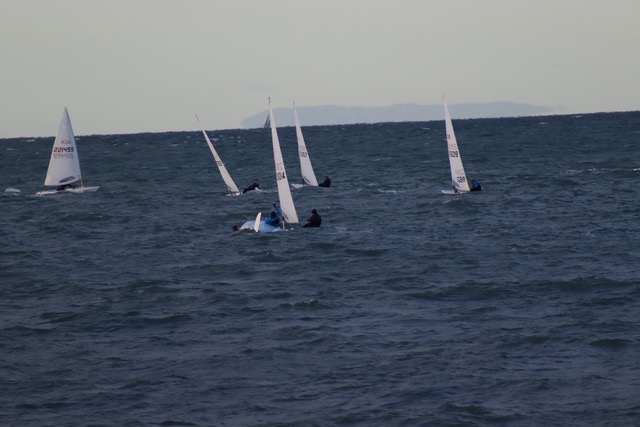
Wild weather and technical challenges produce a rare draw in the fast handicap fleet.
by Diane Nelson
Round Four of Part Two of the Sunday Taggart’s Icebreaker Series kept the rescue teams exceptionally busy, with boats capsizing before, during, and after racing. A sincere thank you to all rescue team members for your calm and professional approach in ensuring that capsized sailors were accounted for and safe.
Whilst most weather forecasts teased that racing might take place in the mythical 16 knots, they were wide of the mark. Undeterred, sailers launched from both slipways into a fresh to strong westerly breeze. Racing commenced in 18 knots, which increased throughout, with gusts of up to 25 knots recorded. The day began sunny and mild, but midway through racing, a heavy, dark, low cloud and a squall of horizontal rain made spotting the turning marks decidedly challenging. Those who remained stoic, upright- and dare I say, those of a more solidly built constitution- fared well.
Sailors were set one lap of Butterfly Course Two, followed by one lap of Sausage and Butterfly Course Seven, with most competitors finishing in the 50 to 55 minute range.
Only two of the three RS AERO’s completed the race, with Des Magee (RS AERO 6) claiming victory- though it was noted that the coveted AERO chocolate bar was not shared this week. Sandra Halliwell (RS AERO 5) finished in second place.
Three RS 400s, one RS 200, one Laser 2000, and one Melges 15 made up the Fast Handicap fleet, with one RS 400 failing to finish. With the exception of the Laser 2000, all racing boats experienced spinnaker-related technical difficulties during the race. One RS 400’s spinnaker pole would only rotate in one direction, requiring the crew to crawl to the bow in an attempt to rectify the issue, at considerable cost to their race time. The spinnaker pole on the RS 200 refused to move from its stowed position. The Melges 15’s flapping spinnaker was, on this occasion, a crew matter- following a prolonged capsize, the crew was not entirely in command of the sheet, owing to temporarily malfunctioning hands and arms. The cumulative effect of this catalogue of misfortune resulted in a highly unusual draw for the win between Mikey Ferguson and crew (RS 400) and Paddy Oliver and Diane Nelson (Melges 15). Gareth Flannigan and Knox Wilson (RS 400) took third place.
Jonny Cully took first place in the fleet of six ILCA 6’s, with Jess Winton finishing second and Emma Pierce third.
Twenty-one ILCA 7’s started the race, with three failing to finish. Colin Leonard claimed first place, with Hammy Baker and Conor Simms finishing second and third respectively. Rumour from the dance floor has it that two sailers near the back of the fleet became entangled during a side-by-side capsize, making righting their boats something of a joint challenge.
Matthew Holden raced hard against himself- and won the Slow Handicap race.
Ed Winton claimed first place in the Whiskey Cup fleet, once again finishing ahead of Alex Ward.
Mackey’s Opticians Mug of the Day was awarded to Hammy Baker who, as an RYA Performance Manager, was not so gently reminded that leading the race to the finish mark- only to capsize at it- is generally considered suboptimal, costing him the lead and relegating him to second place.
A reminder to all sailors who have been participating in races without registering- please do so before taking to the water. Registered entry is essential for fair, safe and well-managed racing. Unregistered participation impacts fellow competitors, the scoring crew and the rescue team. Your cooperation to do the right thing is expected and greatly appreciated.
Finally, a huge thank you to all on-shore and off-shore volunteers—without whom none of this organised sailing would be possible.
From the depths of sailing knowledge:
- Sailors measure speed in knots rather than miles per hour because of an old practice of throwing a wooden board tied to a knotted rope overboard and counting how many knots passed through their hands in 30 seconds. So technically, every sailor who has ever complained about only doing 6 knots was once counting rope by hand.
- Capsizing is officially defined as a boat heeling beyond the point of no return. On Sunday, several competitors appeared to treat this less as a point of no return and more as a scheduled stop.